





















There are certain games that make you question what genre you’re actually playing.
Planet Crafter is one of those games.
At first glance, it looks like a straightforward space survival game. You’re stranded on an alien planet, gathering resources, building shelter, crafting equipment, and trying not to die.
Then you start automating things.
Suddenly you’re building machines, managing resources, expanding production, and watching your planet slowly transform around you.
And that’s when the debate begins:
Is Planet Crafter a survival game? A factory game? An idle game?
Or perhaps the answer is all three.
In this episode, we dive into Planet Crafter, exploring its survival mechanics, automation systems, terraforming progression, exploration, story, graphics, multiplayer, and the surprisingly complicated question of what kind of game this actually is.
Gameplay: Survival Meets Automation
At its core, Planet Crafter is a very approachable crafting survival game.
“This game is a very simple entry-level crafting survival game.”
The premise is straightforward.
You’re dropped onto an inhospitable alien planet and tasked with transforming it into a livable environment. To do that, you need to gather resources, build equipment, manage oxygen and other survival requirements, and gradually expand your base.
Early on, the experience feels very much like traditional survival gaming.
You’re searching for materials.
You’re crafting better equipment.
You’re trying to figure out where everything is.
And you’re probably wondering how you’re supposed to survive on this giant rock without immediately running out of oxygen.
But eventually, something changes.
You stop simply surviving the planet.
You start changing the planet.
Terraforming Is the Real Progression System
Terraforming is what gives Planet Crafter its identity.
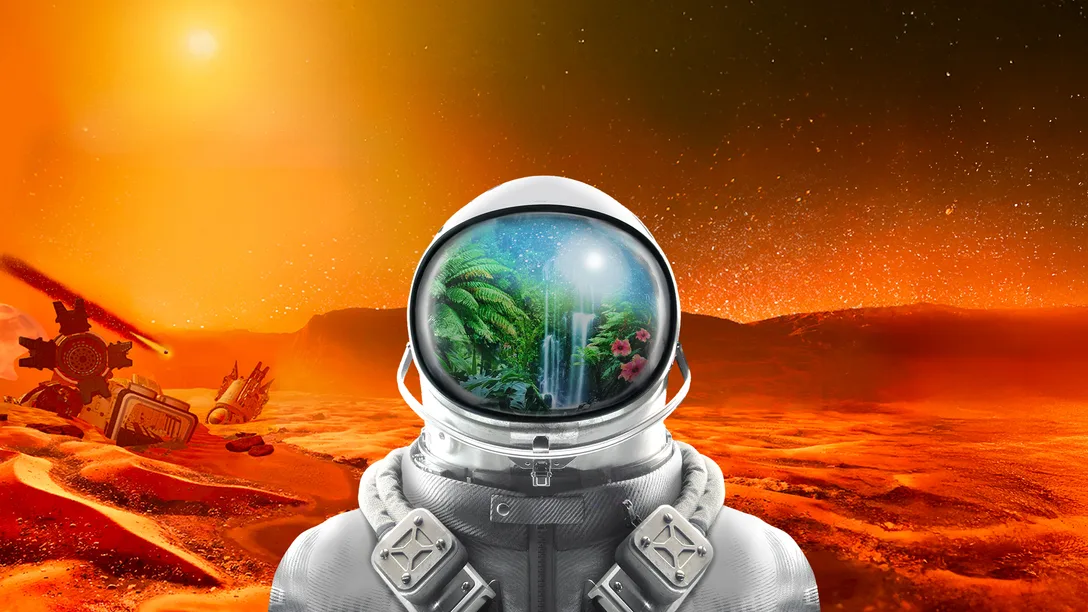
Instead of simply building a bigger and better base, your ultimate objective is to transform the planet itself.
As your terraforming efforts progress, the environment begins to change.
The planet gradually becomes more hospitable, creating a tangible sense that your actions are having an impact.
That makes progression feel different from a traditional survival game.
You’re not simply unlocking another crafting station because the game says you need one.
You’re building toward a larger transformation.
Every machine, resource, and upgrade contributes to that bigger objective.
So… Is It a Factory Game?
This is where things get interesting.
Planet Crafter contains plenty of mechanics that will feel familiar to factory-game fans.
You gather resources.
You build machines.
You automate production.
You manage resource chains.
You expand your operation.
Eventually, you’re looking at your collection of machines and wondering whether you’ve accidentally built an industrial complex on an alien planet.
And yet, calling it a traditional factory game doesn’t quite feel right.
There isn’t the same emphasis on complex production chains that you’d find in more dedicated factory games.
Instead, automation exists largely to support your survival and terraforming progression.
So perhaps it’s a factory-lite survival game.
Or maybe…
“It’s an idle game with a little survival in it.”
Honestly, that argument starts making more sense the longer you play.
The Idle Game Argument
One of the most interesting aspects of Planet Crafter is how much progress can happen without constant player intervention.
Once you’ve established your systems, machines continue producing resources and contributing to terraforming.
You can step away.
Come back later.
And suddenly you’ve got more resources, higher terraforming numbers, and new things to build.
That creates an almost idle-game quality to the experience.
You’re constantly watching numbers increase and waiting for the next major milestone.
It’s oddly satisfying.
The game gives you enough to actively manage while simultaneously allowing your systems to continue working in the background.
That makes Planet Crafter feel less stressful than many traditional survival games.
Exploration: There’s More Than Just Your Base
Despite all the automation, exploration remains an important part of the experience.
The planet contains resources, abandoned structures, hidden areas, and environmental discoveries that encourage you to leave your increasingly comfortable base.
Exploration also feeds directly back into progression.
You need resources to build your machines.
You need new materials to unlock better technology.
And you need to venture farther into the planet to find some of the things required to keep expanding.
That creates a nice rhythm:
Explore → Gather → Build → Automate → Terraform → Explore Further.
It’s a simple loop, but an effective one.
Story and Lore
The narrative in Planet Crafter takes a back seat to the gameplay.
The basic premise provides enough context to explain why you’re there and what you’re trying to accomplish, while environmental discoveries and alien remnants help flesh out the world.
The alien species and the history of the planet provide additional layers for players who want to investigate.
But this isn’t a narrative-heavy survival game.
The story exists primarily to support exploration and give the terraforming project a larger purpose.
For players who enjoy uncovering lore at their own pace, there’s something to discover.
For anyone looking for a deeply character-driven science-fiction story, this probably isn’t that game.
Graphics: Functional Rather Than Spectacular
Visually, Planet Crafter isn’t trying to compete with the biggest AAA science-fiction games.
Its environments are functional, readable, and occasionally quite beautiful, particularly as the terraforming process begins changing the landscape.
The transformation itself is one of the more visually satisfying parts of the game.
Watching a barren alien environment slowly become more alive gives your progression a physical representation.
That matters.
The graphics may not always impress on a technical level, but the game uses its visuals effectively to communicate progress.
Audio and Atmosphere
The audio design takes a similar approach.
Rather than overwhelming the player with constant music and dramatic effects, the game creates a relatively quiet atmosphere that emphasizes isolation.
You’re alone on an alien planet.
You can hear the environment.
You can hear your equipment.
And sometimes, there’s a lot of nothing.
That works surprisingly well.
The relative quiet reinforces the feeling that you’re building a new world from scratch.
Progression: From Survival to Civilization
One of the most satisfying parts of Planet Crafter is how dramatically the experience changes over time.
Early game:
“How do I get oxygen?”
Later:
“How many machines can I fit in this facility?”
That’s a pretty substantial transformation.
The progression system gradually introduces new technologies, resources, automation options, and terraforming milestones.
Eventually, the game can feel less like survival and more like managing an increasingly elaborate operation.
The presence of multiple planets and additional progression opportunities also gives players reasons to continue beyond the initial survival experience.
Co-Op Makes the Grind Better
Planet Crafter also benefits from cooperative play.
Playing with others changes the experience considerably.
One player can focus on gathering resources while another expands the base. Someone else can explore while the rest of the group works on automation.
That division of labor makes the game’s progression feel faster and more social.
And, naturally, it also means you can have four people standing around arguing about where the storage containers should go.
The true test of any multiplayer survival game.
What Works
Planet Crafter succeeds because its systems complement each other well:
- Accessible survival mechanics
- Satisfying terraforming progression
- Simple automation
- Relaxing exploration
- Resource management
- Cooperative gameplay
- A tangible sense of environmental change
- Strong progression from survival toward automation
It doesn’t overwhelm players with unnecessary complexity.
Instead, it gradually introduces systems and lets the player build toward something bigger.
What Doesn’t
The game’s simplicity can also be its biggest limitation.
Players who want deep factory mechanics may find the automation systems too basic.
Hardcore survival fans may find the experience too forgiving.
And players expecting a massive narrative experience may find the story relatively light.
The graphics and audio also aren’t likely to impress players looking for a technical showcase.
But those limitations are somewhat tied to the game’s design philosophy.
Planet Crafter isn’t trying to be the most complicated survival game ever made.
It’s trying to be accessible.
Final Thoughts
So, what exactly is Planet Crafter?
A survival game?
A factory game?
An idle game?
The answer may depend entirely on what part of the experience you find most satisfying.
If you enjoy gathering resources and surviving an alien environment, it’s a survival game.
If you love building automated systems and watching resources flow, it’s starting to look like a factory game.
And if you find yourself checking your terraforming numbers, waiting for machines to produce resources, and returning later to see what changed…
Well.
Maybe the idle-game argument isn’t so crazy after all.
What makes Planet Crafter work is that it doesn’t need to fit perfectly into one category.
It’s an accessible space survival game that gradually transforms into an automation and terraforming experience. The mechanics are simple enough for newcomers while still providing enough progression to keep players building, exploring, and improving.
It may not satisfy hardcore factory enthusiasts or survival purists looking for brutal difficulty.
But if you want a relaxing science-fiction adventure where your ultimate goal is to take an empty planet and slowly turn it into something alive, Planet Crafter is an easy game to recommend.
And yes, we’re still not completely sure whether we’re crafting the planet or the planet is crafting us.